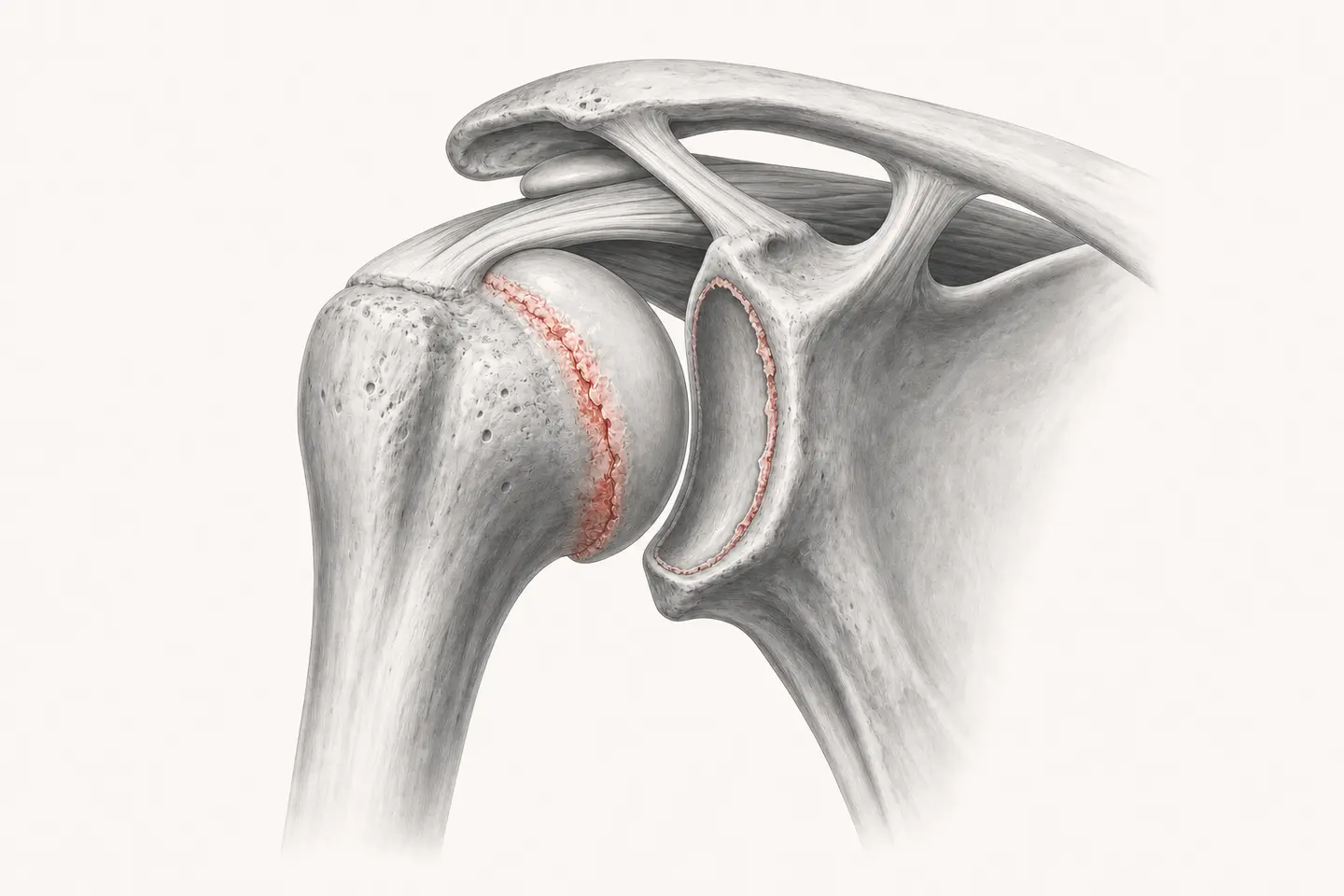
Shoulder Arthroplasty
Specialized management by Dr. Stéphane Vasseur
Key Information
- Hospitalization: 3 to 5 days
- Anesthesia: Regional + General
- Immobilization: Elbow-to-body splint 45 days
- Dressings: Every 5 days (resorbable sutures)
- Rehabilitation: 3 to 6 months
Indications
Surgical treatment in the context of shoulder osteoarthritis consists of articular prosthesis implantation. The principle of this surgical intervention is to replace damaged bone and cartilaginous structures with prosthetic implants fixed in the bone.
When to perform surgical intervention?
- In case of persistent pains and functional impairment
- In case of functional discomfort, joint blockage and autonomy loss (use of the concerned arm)
For more information on the pathology: Shoulder Osteoarthritis - Complete Pathology
Principle and types of prostheses
There are two main types of shoulder articular prosthesis aiming to restore joint function and mobility.
Anatomical prosthesis
So-called anatomical prostheses will preserve shoulder physiological anatomy with a convex prosthetic piece at the humeral head level and a concave piece at the glenoid of the scapula level.
This prosthesis is indicated for centered osteoarthritis with intact rotator cuff. Preserved morphology (convex humeral head / concave glenoid). Stemless or short stem options to preserve bone; materials (pyrocarbon) aiming to limit glenoid wear.
Reverse prosthesis
Conversely, so-called reverse prostheses modify physiological anatomy with placement of a concave prosthetic piece at the humeral head level and a convex piece at the glenoid of the scapula level.
This prosthesis is indicated for eccentric osteoarthritis with rotator cuff rupture. Biomechanics inversion (convex glenoid / concave humerus) to mobilize the shoulder thanks to the deltoid.
Hemi-prosthesis
More specific indications according to lesions and bone quality.
Prosthesis type choice (anatomical/reverse) will be made according to preoperative assessment (arthro-CT or arthro-MRI), will depend on multiple factors including associated rotator cuff lesions, joint deformation importance particularly of the glenoid of the scapula, possible joint subluxations…
Computer-assisted preoperative planning will help optimal prosthetic implant placement for the best possible functional result.
Planning and imaging
Arthro-CT or arthro-MRI completes X-ray to confirm early/localized stages, assess rotator cuff and bone stock, and plan implant type/positioning (humeral and glenoid).
Computer-assisted preoperative planning will help optimal prosthetic implant placement for the best possible functional result.
This examination allows in particular:
- Detection of chondropathy lesions at little advanced stages
- Detection of polar wear lesions, particularly posterior or anterior
- Reliable estimation of possible humeral head deformation
- Bone stock assessment, particularly at the glenoid of the scapula and humeral head level (essential element before articular prosthesis implantation)
- Evaluation of rotator cuff tendons with in case of rupture estimation of muscle atrophy, amyotrophy and retraction importance
- Staging of chondropathy degree (stage I to IV) and possible osteoarthritis
Postoperative course and rehabilitation
- Comfort immobilization 2–4 weeks
- Progressive mobilization, strengthening from 6–8 weeks
- Pain and function improve over 3–6 months
Risks
- Stiffness, dislocation (especially reverse), infection (rare)
- Late loosening